


Read this first. Regulations change without notice and avian influenza zones can change with little warning. This page is guidance, not authorisation. Confirm every requirement with CFIA, APHIS, USFWS and ECCC before you travel — contact numbers are at the bottom of this page. Do not book a flight or drive to a border on the strength of this page alone.
If you’re moving abroad and your bird can’t fly out with you on the same ticket, you are not choosing between “make it work” and “give the bird up.” There are four real paths: long-term boarding while your paperwork clears, a staged move where you go first and the bird follows, a foster-to-return arrangement with someone you trust, or rehoming. Which one fits depends on your timeline, your destination, and your bird’s species.

You are probably not choosing between two options — there are four
Almost everything written about relocating with a pet bird frames the decision as binary: take the bird, or give it away. That framing ignores the part of the process that actually eats the most time — waiting. A permit application, a residency requirement, a quarantine window, or a species restriction can take weeks to resolve, and during that wait your bird still needs somewhere to live. That’s a fifth thing to plan for, not an afterthought, and it’s the gap this whole cluster exists to fill. For the general Canadian import picture, see our complete Canadian guide to moving abroad with a pet bird.
| Option | Best when | Bird’s location during the wait | Ends with |
|---|---|---|---|
| Long-term boarding | Permit or quarantine wait, HPAI zone restriction, or you simply aren’t ready to travel with the bird yet | A boarding facility (e.g. BST) in the GTA | Bird rejoins you once cleared |
| Staged relocation | Rules require the owner to accompany the bird, or the household move is too chaotic for a stressed bird | Boarding, then travel once you’re settled | Bird flies to join you after your own move is done |
| Foster-to-return | A wait longer than boarding makes sense for, with someone the bird already knows | A trusted person’s home, under a written agreement | Bird returns to you, by agreement |
| Rehoming | The move is permanent, the destination’s rules genuinely can’t be met, or the bird’s age/health makes travel unsafe | N/A — ownership transfers | Bird stays in Canada with a new owner |

Option 1 — long-term boarding while the paperwork clears
Boarding is the option most people don’t know exists, because most content about moving with a pet bird assumes the trip happens on one date. In practice, permit processing, a residency clock, or a quarantine window often means the bird’s departure has to happen later than yours.
Who this is for: permit waits, quarantine windows, an HPAI zone that has not lifted
Three situations tend to force a delay. First, a destination country requiring an individual import permit rather than issuing them on demand — for example, importing a personally-owned parrot into the United States as a pet requires a permit under 50 CFR 15.25, and that permit is not automatic. Second, a quarantine period set as a condition of an individual permit rather than published as a blanket rule — Unconfirmed: we could not verify this against an official source — specifically, current quarantine length or conditions, if any, attached to a specific individual’s US import permit. Please confirm with USDA APHIS Veterinary Services at aphis.usda.gov/pet-travel before you rely on it for your own bird.. Third, an active animal-health restriction such as a highly pathogenic avian influenza (HPAI) control zone at either end of the trip — Unconfirmed: we could not verify this against an official source — specifically, whether an HPAI-related import or export restriction currently affects your specific route. Please confirm with the Canadian Food Inspection Agency at 1-800-442-2342 before you rely on it for your own bird..
Useful context, even though it describes imports into Canada rather than your destination: under the Import Reference Document, which is incorporated by reference into the Health of Animals Regulations, “the world is an undesignated area for regulated animals” — no country currently has equivalent-risk or low-risk status, so parrot imports from outside the United States proceed under an individual permit rather than a blanket certificate — not most of them, all of them, because there is no lower-risk designation for any country to qualify under. Many destination countries work the same way: permits are assessed case by case, not issued off a published schedule, which is exactly why the wait is often measured in months rather than days.
What a 3-, 6- and 9-month stay actually involves
Practically, a long boarding stay isn’t different in kind from a short one — it’s the same daily care repeated for longer, which is why continuity of diet, environment and routine matters more the longer it runs. What changes is planning: confirming the facility can commit the space for the full window, agreeing how updates work over a period when you may be in a different time zone, and deciding in advance what happens if the permit takes longer than expected. See our sister page on boarding, staged relocation and the rehoming question during a move for how these pieces fit together.
Option 2 — staged relocation: you go first, the bird follows
A staged relocation means you complete your own move, get settled, and only then bring the bird over — rather than trying to move both of you, and the rest of your household, on the same date.
Why this is often better for the bird than travelling mid-move with a stressed household
A household mid-move is a bad environment for a bird regardless of the border rules — packed boxes, unfamiliar noise, disrupted schedules, and often a chaotic travel day. Delaying the bird’s own trip until your new home is set up, quiet and ready removes that stress from the equation entirely, independent of any regulatory reason to wait.
Who accompanies the bird when the rules require an owner present
This matters most for moves into the United States, and it isn’t a formality. Under 50 CFR 15.25, the personal-pet import permit is tied to the owner, and the operative eligibility test is documented continuous residence outside the United States for at least one year — stated as an application requirement and again as an issuance criterion. Nothing in the regulation requires the applicant to be a US citizen or a returning US resident; on the face of the rule, a Canadian who has lived in Canada for a year or more qualifies. The same permit caps any one person at importing no more than two exotic birds as personal pets in a single year, and makes it a standing condition that the bird cannot be sold after it enters the US. If you’re moving into the US specifically, our Canada–US border walkthrough covers the crossing itself in detail. For every other destination, confirm directly with that country’s import authority whether the permit-holder must personally accompany the bird — Unconfirmed: we could not verify this against an official source — specifically, owner-presence requirement for the specific destination country — that country’s agriculture or wildlife import authority. Please confirm with the relevant agency listed at the bottom of this page before you rely on it for your own bird..
Option 3 — foster-to-return
Foster-to-return means someone the bird already knows — a family member, a close friend, a former sitter — keeps the bird for a defined period, with the explicit intention that the bird comes back to you.
How it differs from rehoming, and how to make it enforceable rather than a handshake
Rehoming transfers ownership permanently. Foster-to-return does not — the bird is still yours, held temporarily. The risk is that an undocumented “we’ll figure it out” arrangement can quietly become permanent if circumstances change on either side. Put it in writing: who owns the bird, the agreed return date or trigger event, who pays for food and vet care in the meantime, and what happens if either party’s situation changes. It costs nothing and it’s the difference between a temporary favour and an accidental rehoming. If the bird may need to come back into Canada from the US at the end of a foster period, note that under section 13 of the Import Reference Document, the importer must be the owner and must personally accompany the bird — a foster carer cannot bring it across on the owner’s behalf.
Option 4 — rehoming, and when it is genuinely the kindest answer
Sometimes boarding, staged relocation and foster-to-return are all worse options than finding the bird a new, permanent home in Canada — and saying so plainly is more useful than pretending otherwise.
Age, illness, destination quarantine length, and permanent one-way moves
Rehoming tends to be the right call when the move is genuinely permanent with no planned return to Canada, when the bird is elderly or managing a health condition that makes long-distance travel or a long quarantine risky, or when the destination’s import conditions — quarantine length, permit refusal, species restrictions — simply can’t be met for that particular bird. None of these are boarding or transport problems; they’re better solved by finding the bird a stable home here than by forcing a move that isn’t in its interest.
How to rehome responsibly in Ontario, including the rescues we refer to
Bird Sitting Toronto offers rehoming help as one of its core services, alongside boarding — matching a bird with a vetted new owner rather than listing it and hoping. For care guidance and community support during that process, our sister sites learn.birdsittingtoronto.ca and forum.birdsittingtoronto.ca are free to use, and rehoming.birdsittingtoronto.ca is set up specifically for this. BST does not file permits, complete applications, or act as a customs broker for anyone — its role here, as with boarding, is caring for the bird and finding it the right home, not handling your paperwork.
What long-term boarding looks like at BST
If boarding is the right option for your situation, here’s what it actually involves day to day.
Daily update videos through the client portal so you can watch from another country
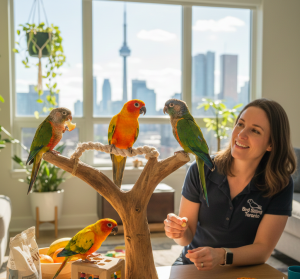
Every BST stay includes daily photo and video updates through a client portal, which matters more, not less, once you’re in a different time zone. You get to see your bird eating, active and settled without needing anyone local to check in on your behalf.
Diet continuity, fresh chop, and keeping their own cage or renting one
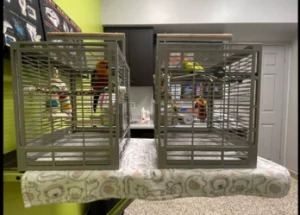
Boarding rates include fresh fruit and vegetables and daily interaction as standard. BST also offers fresh chop delivery to keep a bird on its established diet through a long stay, and either the bird’s own cage or a rental cage — worth deciding in advance for a multi-month stay, since a familiar cage can reduce stress over a long absence.
Grooming, nail and beak care over a long stay
A stay measured in months means at least one grooming cycle will fall during it. BST’s grooming menu covers nail clipping ($30), wing clipping ($40), beak trimming ($40, not offered for small birds) and DNA sexing ($90, which includes a free nail clip); extra-large birds cost more for each service. Rates current at time of writing — check /pricing/ for today’s.
Drop-off, pick-up and airport shuttle logistics
BST runs a drop-off/pick-up shuttle, which is useful when a move means your own last few days in the GTA are consumed by packing, closing accounts and getting to the airport, rather than a separate trip to hand the bird over.
What it costs compared with relocating
The monthly rate is the relevant number here — an owner waiting out a permit is boarding for months, not days. BST’s published monthly boarding rates by bird size are below; all include daily photos/videos, food and water, fresh fruit and vegetables, and interaction. Multiple birds housed together get 50% off each additional small bird and 25% off each additional medium or larger bird. Statutory holidays and peak season carry a surcharge, and a deposit secures the dates.
| Size category | Examples | Monthly rate |
|---|---|---|
| Small | Budgie, canary, finch | $360 |
| Medium | Conure, cockatiel, Quaker | $480 |
| Large | Caique, ringneck, pionus | $600 |
| Extra large | Eclectus, African grey, cockatoo | $720 |
Rates current at time of writing — check /pricing/ for today’s. Set that monthly figure against what a compressed, all-at-once relocation would actually cost — rebooking flights to avoid travelling with a bird mid-move, an expedited permit application if one is available, or a shortened but riskier timeline — and for most people waiting out the paperwork with the bird boarded is the cheaper and calmer choice, not just the more convenient one.
How to hand over a bird for months without breaking the bond
A long stay away from you doesn’t have to weaken your relationship with your bird if you set it up deliberately. Send the bird with familiar items — a favourite toy, its own dishes, a blanket that smells like home — rather than starting fresh with facility-provided everything. Write out its diet, routine and any quirks in as much detail as you’d give a new sitter, even if the facility already knows birds well; specifics matter more than general competence. Use the update videos actively rather than passively — most birds settle faster when the human side of the relationship keeps some continuity, even filtered through a screen. And agree on a realistic pickup or shipping plan before the wait starts, so “a few more weeks” doesn’t become an open-ended stay by default.
What happens if your permit is denied or your bird is refused at the border
This is worth planning for before you travel, not after. Under the Import Reference Document, if a CFIA inspector has reason to believe a bird is not in good health, they may refuse it admission — or, if it has already been admitted, order it removed from Canada or destroyed. Separately, where an animal does not qualify for import at all, the importer will be ordered to remove it from Canada under section 18 of the Health of Animals Act within a specified period, and must comply. These are the consequences on the Canadian import side; the practical fallback in either direction is the same. If your bird is turned back or your permit is refused, having a boarding arrangement already in place — rather than scrambling for one at the airport — is what keeps the bird safe while you sort out next steps, whether that’s reapplying, choosing a different destination, or deciding rehoming is the better path after all. What the specific appeal process, timeline or refund situation looks like for a denied permit varies by agency and case — Unconfirmed: we could not verify this against an official source — specifically, appeal or reapplication process for a denied import permit — the issuing agency, e.g. USDA APHIS or CFIA. Please confirm with the Canadian Food Inspection Agency at 1-800-442-2342 before you rely on it for your own bird..
If you’re in the middle of sorting this out and need somewhere stable for your bird while the paperwork clears — for a few weeks or several months — a quote from Bird Sitting Toronto is a good next step.
Frequently asked questions
Can I board my bird for a full year if my permit takes that long?
BST doesn’t publish a maximum stay length, so a long-term arrangement is something to discuss directly rather than assume — get in touch with your expected timeline and confirm space and rate details for the full period before you commit.
Does BST help with the permit application itself?
No. BST boards birds and helps with rehoming — it does not file permits, complete applications, liaise with any government agency, or act as a customs broker. Everything on this page about permits and rules is informational; confirm the specifics with the relevant agency directly.
Is it cheaper to board my bird for months or to change my flight to travel with it sooner?
It depends on the flight change fees and how close you are to being eligible to travel with the bird at all. Compare BST’s published monthly rate for your bird’s size against the actual cost of rebooking before deciding — for most multi-month waits, boarding works out lower.
Can a family member bring my bird into Canada or the US for me if I can’t travel with it?
Not under the personal-pet route on either side of the border. Entering Canada from the US, section 13 requires the importer to be the owner and to personally accompany the bird. The US personal-pet permit under 50 CFR 15.25 is likewise tied to the permit holder. Unconfirmed: we could not verify this against an official source — specifically, whether any exception applies to your specific situation. Please confirm with the Canadian Food Inspection Agency at 1-800-442-2342 before you rely on it for your own bird.
My bird was a rescue and I have no paperwork proving where it came from — can I still get a US pet permit?
50 CFR 15.25(a)(5)(ii) accepts more than a CITES permit as proof of legal acquisition: a sales receipt or signed statement from the seller with their name, address, date of sale and the bird’s species, or a signed breeder’s certificate with the breeder’s name, address, date and species. If you have none of these, Unconfirmed: we could not verify this against an official source — specifically, what alternative evidence, if any, USDA APHIS will accept. Please confirm with USDA APHIS Veterinary Services at aphis.usda.gov/pet-travel before you rely on it for your own bird..
Is my species even allowed into the United States as a pet?
Check it against the 50 CFR 15.33 approved species list before assuming a permit will fix it. Budgerigars, cockatiels, Indian ringnecks, peach-faced and masked lovebirds, Jendaya conures, lineolated parakeets, Pacific parrotlets, several Neophema species, rosellas, Alexandrine parakeets and scaly-breasted lorikeets are on the approved list. African greys, all macaws, all amazons, all cockatoos, eclectus, caiques, senegals, pionus, and every conure except the Jendaya are not — for those, the Wild Bird Conservation Act prohibition applies and the 15.25 permit route is what you need. This is a separate question from CITES status; a bird can be CITES-listed and still be on the 15.33 approved list, or not on it despite no CITES restriction at all, so check both independently.
Can I bring more than one bird with me when I move to the US?
Under 15.25, no individual may import more than two exotic birds as personal pets in a single calendar year. If you have more than two, Unconfirmed: we could not verify this against an official source — specifically, how additional birds beyond the personal-pet cap can be imported, if at all. Please confirm with USDA APHIS Veterinary Services at aphis.usda.gov/pet-travel before you rely on it for your own bird..
Can I sell my bird after moving it into the US?
No. 50 CFR 15.25(c) makes it a standing condition of the personal-pet import permit that the bird cannot be sold after it enters the United States.
Related guides in this series
- Rehoming a Bird Because You’re Emigrating: How to Do It Without Wrecking the Bird
- Importing a Pet Bird to Canada: The Complete CFIA Guide (2026)
- Long-Term Bird Boarding While You Relocate: 30, 60 and 90+ Days
- Taking Your Bird from Canada to the United States: Driving vs Flying
- Bringing a Pet Bird to Canada From Outside the US: Why You Need a Permit
- Can I Fly Inside Canada With My Parrot? Domestic Rules by Carrier
Who to call before you travel
Confirm every requirement below with the agency itself. These are the people who
can actually authorise your bird’s movement — we cannot.
Every number below was checked against the agency’s own website on
27 July 2026. Government phone numbers and web pages still change without notice.
If one does not connect, find the agency through its own official site rather than trusting
what is printed here.
- Canadian Food Inspection Agency (CFIA) — import and export of live
birds, health certificates, permits: 1-800-442-2342 from
Canada and the US, or 1-613-773-2342 local and
international, 8 am to 7 pm EST Monday to Friday except holidays. CFIA names
services related to travelling with pets as something its area offices handle —
for the GTA that is the Mississauga animal health office,
289-247-4100, 8 am to 4 pm
· inspection.canada.ca - Environment and Climate Change Canada — CITES permitting — export and
import permits for CITES-listed species, and what documents exist for repeat crossings:
1-855-869-8670
· cites@ec.gc.ca - Canada Border Services Agency — what happens at the border itself,
declarations and inspection fees: 1-800-461-9999, Monday to
Friday 8 am to 4 pm local time. Press 0 to reach an agent; CBSA’s published
service standard is to answer within 20 minutes - USDA APHIS — the US pet-travel hub, with separate paths for import,
export and interstate movement, and the list of which birds count as pets at all:
aphis.usda.gov/pet-travel - US Fish & Wildlife Service — CITES and Wild Bird Conservation Act
permits, applied for through the ePermits portal at
fws.gov/permits. The agency
contact centre is 1-800-344-9453
· info@fws.gov
What we can and cannot help with
We cannot help with paperwork. Bird Sitting Toronto is a bird
boarding and care business. We are not a customs broker, an immigration consultant, a
veterinary practice or a legal adviser. We do not file permits, complete applications or
deal with any agency on your behalf, and we cannot guarantee any outcome at any border.
Everything on this page is information only.
There are two things we can do. If your bird cannot travel with you
— because the paperwork is still in progress, the airline will not carry it, or the
timing simply does not work — we can board
your bird in the GTA for as long as you need, including by the month. And if it
becomes clear the bird genuinely cannot come with you, we can help you
rehome it to a good home rather
than leaving you to sort that out alone.
We publish this guide because our boarding clients ask us about it constantly, and
because the answer is genuinely hard to assemble from the primary sources.
Corrections
Where we have found a material error on this page — a wrong fee, day-count, phone number or country status — we fix it and record the fix here rather than editing quietly.
- 27 July 2026 — We had listed 1-800-358-2104 as the US Fish & Wildlife Service Office of Law Enforcement number. That number is widely repeated online but does not appear anywhere on the current fws.gov, so we have replaced it with the contact route the agency does publish — the ePermits portal and its agency contact centre. Every other number in that section was re-checked against the agency’s own website the same day, and CBSA’s border information line has been added.
- 27 July 2026 — We wrote that “most” parrot imports proceed under an individual permit. That understated what the Import Reference Document actually says: because the world is an undesignated area and no country holds equivalent-risk status, it is not most of them but all imports from outside the United States. Corrected to say so.

Cargo Hold vs Cabin for Birds: What Really Happens
Can a bird fly in the cargo hold? Here’s what airlines allow, the real risks involved, and why cabin travel is safer for your feathered companion.
Is Flying Safe for a Parrot? What Canadian Law Actually Requires
Is flying stressful for parrots? Learn what Canadian law requires for safe travel and how to tell if your bird is truly ready to fly.
Microchipping and Leg Bands for International Bird Travel
Learn how to microchip your parrot for travel in Canada, plus leg band rules, so your bird meets international ID requirements before you fly.