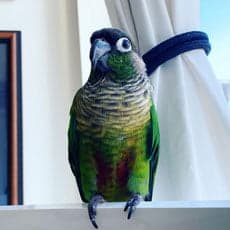
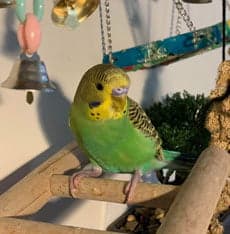
Ask five parrot owners how often to bathe a bird and you get five numbers. The number is not the answer. The Association of Avian Veterinarians ties bathing frequency to where the species evolved — which means a green-cheek conure and a cockatiel, two birds that may sit a metre apart in the same living room, do not want the same thing.
The short answer
You offer a bath. Whether it is taken is the bird's decision, not yours.
- Rainforest parrots — Amazons, macaws, conures — daily.
- Drier-climate parrots — African greys, cockatoos, cockatiels, budgies — a few times a week.
That split is the AAV's, in its own words:
"In general, parrots should be given the opportunity to bathe a few times per week. Parrots originating from rainforest environments (Amazons, macaws, conures) require more frequent bathing (daily) than parrots from drier climates (Old World species such as grey parrots, cockatoos, cockatiels, budgerigars)."
— Association of Avian Veterinarians, How to Introduce Bathing to Your Bird (2024)
By species
| Your bird | Where the wild population lives | How often to offer a bath |
|---|---|---|
| Amazon parrot | Central and South American forest | Daily |
| Macaw | Central and South American forest | Daily |
| Conure | Central and South American forest | Daily |
| African grey | Old World, drier climate | A few times a week |
| Cockatoo | Australia, drier climate | A few times a week |
| Cockatiel | Australia, drier climate | A few times a week |
| Budgie (parakeet) | Australia, drier climate | A few times a week |
If you searched for parakeet and found budgie, they are the same bird: in Canada and the US "parakeet" almost always means a budgerigar, an Australian arid-country species. It sits on the "few times a week" side.
For anything not on that list — a Quaker, a lovebird, an Indian ringneck, a parrotlet — the question to answer is where the wild birds live, not what the bird next to it in the shop was doing.
The thing this page used to get wrong
Until today this article said 2–3 baths a week for every parrot, and that bathing more often would "strip their feathers of essential oils". That is a myth, and it is worth taking apart properly, because it is the single most repeated claim about bathing birds.
Water does not strip anything. Soap does. The AAV's safety note is explicit: do not add soaps, detergents or other additives, because they "can destroy feather waterproofing abilities or pose a toxic risk if ingested". Plain lukewarm water is the whole product.
And the bird the AAV says to bathe daily has no oil gland to strip. The uropygial gland — the preen or oil gland at the base of the tail — is absent in doves, pigeons, Amazon parrots and hyacinth macaws. An Amazon has nothing there to wash away.
The documented risk runs the other way. In the AAV's words, a bird without access to bathing "may develop dry flaky skin, especially on the feet, which may contribute to feather-destructive behaviors" — that is, to plucking.
The one real reason to bathe less
There is a genuine caution, and it is not about oils. The AAV notes that "an increase in bathing frequency can trigger unwanted reproductive-driven hormonal behaviors" in some birds. If a bird has started regurgitating on you, guarding a corner of the cage or shredding paper into a nest, bathing frequency is one of the things worth pulling back before anything else changes. It is a hormone question, not a feather question.
How to actually offer one
Not every bird bathes the same way, and a bird that runs from a spray bottle is not a bird that dislikes water. The AAV lists four ways in and they are worth trying in order:
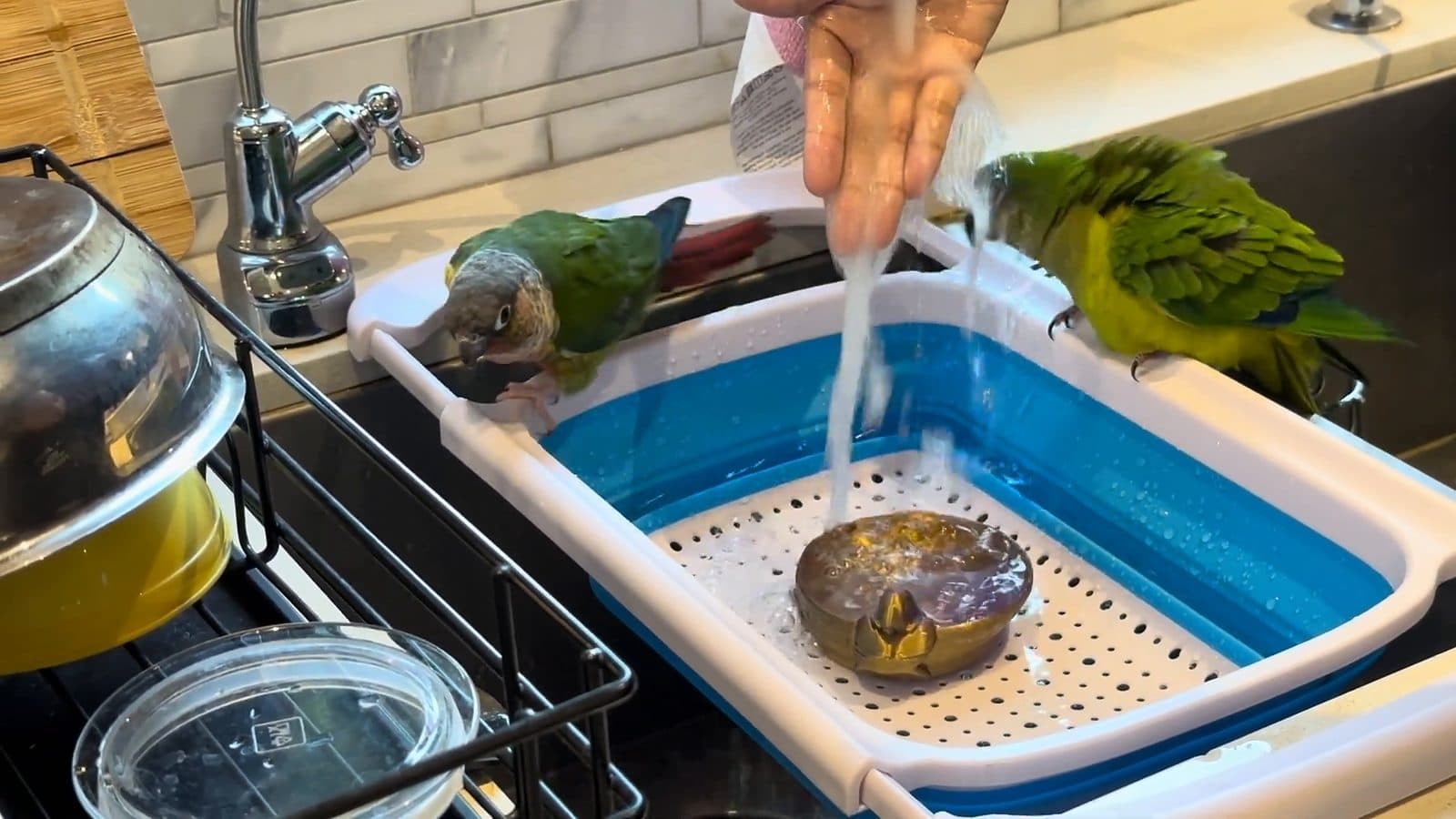
- A shallow saucer, filled one to two inches. Putting your own fingers in the water is often what starts it.
- A fine mist sprayed upwards, so it falls like rain — not aimed at the bird. That wording is the AAV's, and it matters: their own section on frightened birds names spray bottles as the method birds most often have "a negative experience" with. A bird that runs from the bottle may only be objecting to being shot at.
- The shower with you, with a suction-cup perch on the wall. Never left unattended.
- A wet kale leaf clipped inside the cage, rinsed and left to drip.
Never use the spray bottle as a punishment for anything. A bird that has learned the bottle means trouble is a bird you have to re-teach from the beginning.
Drying: mostly, don't
The AAV's answer is short — "Generally, no, it is not necessary to dry your bird off." They shake, then preen, and preening is half the point of the bath. A gentle pat with a towel is fine if your bird likes it.
Never a hair dryer, and the reason is bigger than the heat. The AAV's warning is that hair dryers and new room heaters "may have a polytetrafluoroethylene (e.g. Teflon) coating which can be toxic to your bird" — the same hazard as an overheated non-stick pan, except held six inches from the bird. Burns are the other half of it.
Bathe in the morning, or at minimum several hours before bed, so the bird is dry before the room cools. If the feathers look a different colour while wet, that is normal refraction, not a problem.
Safety, in one list
- Clean, lukewarm water. Change it when it gets dirty.
- Never deeper than the bird can stand up in.
- Never a covered container.
- No soap, no shampoo, no additives of any kind.
- Not if the bird is cold, and not if the bird is unwell — ask an avian vet first.
- Somewhere warm and free of draughts to dry off.
Why Toronto makes this harder in winter
Health Canada's guidance for a home is to hold relative humidity between 30% and 50%, and through a Canadian winter what you actually get is the bottom of that band. A parrot from Central or South American forest evolved in air roughly twice as wet as the room it is now standing in.
So January is when misting matters most — and it is also when a wet bird is easiest to chill. That is the whole argument for bathing in the morning, in a warm room, away from a window.
What that looks like in a house full of birds
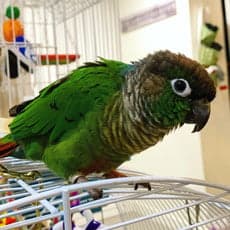
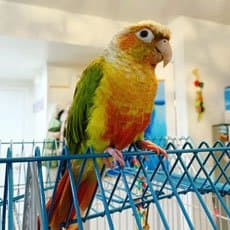
Of the species our boarding records break out, conures are the biggest by a distance, and conures are the daily side of the AAV's line. The next three in our records — budgies, cockatiels and Congo African greys — are all on the other side of it.
Which is the practical point of this whole page: a room with both in it does not have one bathing day. It has two answers, and the bird tells you which.
Corrections
2026-09-08. This article previously recommended 2–3 baths a week for all parrots and also answered "can I bathe my parrot daily?" with "yes" — two answers that contradicted each other on the same page. It also repeated the claim that frequent bathing strips feather oils. Rewritten against the Association of Avian Veterinarians' 2024 owner handout and VCA's veterinary guidance, both linked above.
Going away and worried about who keeps the routine going? We board birds in a family home in Mississauga, not a kennel. What a stay costs →