

Read this first. Regulations change without notice and avian influenza zones can change with little warning. This page is guidance, not authorisation. Confirm every requirement with the agencies listed at the foot of this page before you travel — they are the ones who can authorise your bird’s movement. Do not book a flight or drive to a border on the strength of this page alone.
A pet relocation company can be exactly the right call when you can’t fly with your bird yourself, the destination’s paperwork is layered, or you’ve already relocated and the bird is still working its way through the process. What no company can do is remove a legal requirement — starting with whether your bird can even travel unaccompanied at all.

When hiring one is genuinely the right call
Say this plainly: if you cannot travel with your bird, if the paperwork for your destination is complex, or if you’re already overseas and need someone assembling documents on your behalf, a competent relocation agent solves a problem that boarding cannot touch. Bird Sitting Toronto boards birds, and where a bird genuinely cannot travel, helps rehome them — we are not an alternative to a relocation company for a bird that has to reach another country. This article exists to give you the rules a relocation quote has to survive, not to talk you out of hiring one.

What a relocation company actually does — and how to make a quote comparable
A quote to move a bird internationally usually bundles several separate jobs into one number: an appropriate crate and carrier-compliant booking, assembling the exporting country’s paperwork, assembling the destination country’s paperwork, coordinating logistics, and sometimes a person physically present at the border on travel day. Bird Sitting Toronto has not obtained quotes from any relocation company and makes no claim about typical pricing or about the industry as a whole. What we can do is show you which pieces a quote should itemize, because each one maps to a legal requirement below rather than a marketing line item.
| Line item | What it should specify | Covered below |
|---|---|---|
| Crate and in-transit care | Who confirms the crate meets carrier and transport rules, and who feeds, waters and rests the bird | Welfare duties don’t transfer with the invoice |
| Import paperwork (destination country) | Permit or equivalent, and whether the fee buys consideration of the application or a guaranteed outcome | What the CFIA fee buys — and doesn’t |
| Export or re-export paperwork (Canada) | Which ECCC form is being filed, and why, given where the bird was originally hatched or caught | The outbound paperwork |
| Border-day presence | Who physically presents the permit to a CBSA officer for validation, and the backup plan if no officer is on duty | Two problems that can’t be fixed after the fact |
| Accompaniment | Will the owner be travelling with the bird, and if not, which permit covers a bird moving unaccompanied | The accompaniment test |
The accompaniment test that decides whether the simple route is even available
Section 13(1) of the CFIA Import Reference Document — a document incorporated by reference into the Health of Animals Regulations, so it carries the force of law rather than being guidance — sets out the route a personally owned pet parrot or song bird uses to enter Canada from the United States: “A person may import into Canada from the United States pet birds of the parrot family or pet song birds if: the person importing the birds is the owner of the birds, is accompanying the birds, and makes a declaration to a Customs Officer at the place of entry into Canada.”
Read that literally: the owner has to be the one travelling with the bird. A family member cannot use this route on the owner’s behalf, and neither can a relocation agent. The moment a company proposes moving your bird into Canada without you travelling alongside it, section 13 is off the table, and the move becomes a Ministerial permit case under paragraph 12(1)(a) of the Health of Animals Regulations — a permit whose conditions CFIA sets case by case and does not publish as a blanket rule. For the full mechanics of that route, see our guide to importing a pet bird to Canada and how to apply for the CFIA import permit. Ask any company one question before anything else: will I be travelling with my bird, and if not, which permit are we applying for? A company that can’t answer that crisply hasn’t actually priced the job.
What the CFIA fee buys — and doesn’t
CFIA’s Fees Notice sets a charge for consideration of an import permit application — not for the permit itself. Consideration and approval are not the same thing, and any promise that a fee “secures” or “guarantees” your permit is promising something the fee does not buy. That isn’t an accusation against any particular company; it’s a distinction worth checking, because CFIA alone decides the outcome.
The outbound paperwork: the form that costs weeks if it’s wrong
Most pet parrots kept in Canada are of foreign origin — hatched or caught outside the country, even if they’ve lived here for years — and ECCC’s own form index sends a foreign-origin bird to the re-export application, not the export one. Filing the export form for a foreign-origin bird is exactly the kind of wrong-form mistake that costs weeks. ECCC’s service standard commits to a decision within 35 calendar days, and the application form’s own guidance says up to 40 days may be needed — those two figures don’t agree, so plan around the longer one. Neither number moves in your favour if the paperwork is incomplete: an incomplete application doesn’t queue politely, it pauses the clock entirely until the missing information arrives. The useful question for a relocation company isn’t “how fast are you” — it’s “which form are you filing for a foreign-origin bird, and what exactly do you need from me so the application is complete the first time it’s submitted?”
If the bird transits the United States on the way
If the itinerary runs through the United States before continuing on to somewhere else, a separate rule governs that leg alone. 9 CFR 93.107(a) covers in-bond shipments from Canada transiting the US for immediate export, and on its face it conditions that transit on an import permit obtained under 93.103 — the very permit that 93.103(a)(1) excepts for a personally owned pet bird moving under 93.101(c). How those two provisions interact for a pet bird simply changing planes with its owner, rather than moving as a customs-controlled cargo shipment, is not resolved by the regulation’s text, and no company should tell you it is. Unconfirmed: we could not verify this against an official source — specifically, whether a personally owned pet bird transiting a US airport with its owner needs an import permit under 93.103, or whether the 93.101(c) exception carries through. Please confirm with USDA APHIS Veterinary Services at aphis.usda.gov/pet-travel before you rely on it for your own bird. Ask whoever is booking the route whether that connection counts as an in-bond shipment or a passenger transfer, because the answer changes which permit, if any, applies to that single leg.
Two problems that cannot be fixed after the fact
CBSA validation at departure
A Canadian CITES export permit isn’t complete the moment it’s issued — it has to be validated by a CBSA officer at the place the shipment actually leaves the country, who completes box 17 on the permit. ECCC treats that validation as a condition of the permit: without it, the permit isn’t accepted, and the shipment can be held or seized on arrival. Ask any company who is physically standing in front of a CBSA officer with the permit on departure day, and what happens if that officer isn’t available at the hour your flight leaves.
No retroactive permits
ECCC does not issue CITES permits after the fact. If the correct permit isn’t in hand at departure, border officers on either end can hold or seize the bird, and there is no application that undoes that afterward. A relocation company’s real value here is in the sequencing — making sure the right permit exists before travel — not in fixing it once the bird has already left.
Don’t let a Certificate of Ownership get sold to you as a moving document
A CITES Certificate of Ownership sometimes turns up in relocation quotes as though it were the document that lets a bird move countries permanently. It isn’t. The form’s own stated purposes are vacation, exhibition or show, and living part of the year in another country — it’s built for a pet that travels with its owner and comes home, not one that’s leaving for good. Our full breakdown of the Certificate of Ownership covers who it actually suits. If it appears on a quote for a permanent move, ask why.
Heading to the United States? Two limits that follow the owner, not the agent
If Canada to the United States is the actual route, two limits attach to you as the owner rather than to whoever you hire. 50 CFR 15.25 caps personal pet-bird imports at two exotic birds per person per year, and every such import carries a standing condition that the bird cannot be sold afterward. Hiring an agent to handle logistics changes nothing about either limit — they follow the person the birds are imported for, not the company doing the paperwork.
Welfare duties don’t transfer with the invoice
Section 137 of the Health of Animals Regulations states that its transport rules apply to the transport of animals entering or leaving Canada, or moving within it, with no carve-out for pets or private, non-commercial trips. Handing your bird to a relocation company changes who is physically loading, confining and transporting it; it doesn’t remove the standard those duties are held to. Even if you never see the crate yourself, it’s fair to ask what it is, and how your bird will be fed, watered and rested along the route.
Questions to put to any relocation company before you sign
- Will I be travelling with my bird — and if not, which permit covers moving it without me?
- For entry into Canada, are you filing an export or a re-export application, and why, given where my bird was originally hatched or caught?
- What exactly do you need from me so the application is complete on first submission, rather than paused while missing information is chased down?
- Does the fee you’re charging — or that CFIA charges — buy consideration of an application, or a guaranteed outcome?
- Who physically presents my export permit to a CBSA officer for validation at departure, and what’s the plan if that officer isn’t on duty?
- If my route transits the United States, is that leg being treated as an in-bond shipment or a passenger connection, and does that change which permit applies?
- If the destination is the US, has the two-bird-per-year personal import limit and the no-resale condition been explained to me directly?
- Is a CITES Certificate of Ownership part of this quote — and if so, why, given it isn’t meant for a permanent move?
- Who is responsible for my bird’s welfare during transport, and what crate, feeding and rest schedule will be used?
We can’t tell you which company to use. Bird Sitting Toronto hasn’t contacted or evaluated any pet relocation company, and nothing here is an endorsement or a criticism of any of them. A company that answers all of the above clearly is evidence about that company — it isn’t a guarantee, and no one, including us, can promise you a border outcome.
Where boarding honestly fits
This is narrower than people expect: if your bird is already in Canada and you’ve flown ahead, or a permit or CITES application is still working its way through while your bird waits, it needs somewhere stable to live in the meantime. That’s boarding — the one part of a relocation we can actually help with, not the permits, not the CITES paperwork, not the border. As an example of scale rather than a quote for your bird specifically, boarding is billed monthly for stays like this — from $360/month for a small bird up to $720/month for an extra-large one, with a discount if more than one bird boards together (rates current at time of writing — check /pricing/ for today’s). See our guide to long-term boarding during a relocation for how weeks-to-months stays work in practice.
If your bird needs somewhere to stay while your paperwork is in progress, get a boarding quote and we’ll look after the one part of this move that’s actually ours to handle.
Frequently asked questions
Do I need a relocation company if I’m flying with my bird myself?
Not necessarily. If you’re the owner travelling with your bird from the United States, section 13 of the Import Reference Document may be the applicable route on its own. A relocation company earns its fee on the parts you can’t do yourself — layered destination paperwork, or a move where you can’t travel with the bird.
Can a relocation company file my Canadian export or re-export application for me?
Yes, but which form gets filed matters. Foreign-origin birds — most pet parrots in Canada — go through the re-export application under ECCC’s own form index, not the export one, and filing the wrong one is a common source of delay.
Will a relocation company guarantee my import permit gets approved?
No legitimate one can. CFIA’s fee is for considering the application, not for approving it, and no company controls the outcome of a government decision.
Can my bird travel to Canada without me if a company handles everything?
Section 13’s owner-accompanied route doesn’t cover that. A bird moving without its owner falls to a Ministerial permit under paragraph 12(1)(a), with conditions set case by case rather than published as a fixed rule.
Does a CITES Certificate of Ownership cover a permanent move abroad?
No. Its stated purposes are vacation, exhibition or show, and living part of the year abroad — it’s for a pet that comes back with its owner, not one relocating permanently.
Is there a limit on how many birds I can bring into the United States?
Yes. 50 CFR 15.25 caps personal pet-bird imports at two per person per year, and every such bird carries a standing condition that it cannot be sold afterward. That limit attaches to the owner, not to whichever company is hired.
What happens if my export permit isn’t validated by CBSA before departure?
The permit isn’t considered complete without that validation, and the shipment can be held or seized on arrival. There’s no way to obtain the validation, or a fresh permit, after the fact.
Can Bird Sitting Toronto handle my bird’s permits or paperwork?
No. We board birds and, where a bird genuinely can’t travel, help with rehoming. We don’t file permits, complete applications, liaise with any agency, or give immigration advice — this article is information only.
Related guides in this series
- Long-Term Bird Boarding While You Relocate: 30, 60 and 90+ Days
- Importing a Pet Bird to Canada: The Complete CFIA Guide (2026)
- Moving Abroad and You Can’t Take Your Bird: Board, Rehome, or Wait
- Taking Your Bird from Canada to the United States: Driving vs Flying
- When to Start: The Clocks That Decide Your Bird’s Earliest Travel Date
- Bringing a Pet Bird to Canada From Outside the US: Why You Need a Permit
Who to call before you travel
Confirm every requirement below with the agency itself. These are the people who
can actually authorise your bird’s movement — we cannot.
Every number below was checked against the agency’s own website on
27 July 2026. Government phone numbers and web pages still change without notice.
If one does not connect, find the agency through its own official site rather than trusting
what is printed here.
- Canadian Food Inspection Agency (CFIA) — import and export of live
birds, health certificates, permits: 1-800-442-2342 from
Canada and the US, or 1-613-773-2342 local and
international, 8 am to 7 pm EST Monday to Friday except holidays. CFIA names
services related to travelling with pets as something its area offices handle —
for the GTA that is the Mississauga animal health office,
289-247-4100, 8 am to 4 pm
· inspection.canada.ca - Environment and Climate Change Canada — CITES permitting — export and
import permits for CITES-listed species, and what documents exist for repeat crossings:
1-855-869-8670
· cites@ec.gc.ca - Canada Border Services Agency — what happens at the border itself,
declarations and inspection fees: 1-800-461-9999, Monday to
Friday 8 am to 4 pm local time. Press 0 to reach an agent; CBSA’s published
service standard is to answer within 20 minutes - USDA APHIS — the US pet-travel hub, with separate paths for import,
export and interstate movement, and the list of which birds count as pets at all:
aphis.usda.gov/pet-travel - US Fish & Wildlife Service — CITES and Wild Bird Conservation Act
permits, applied for through the ePermits portal at
fws.gov/permits. The agency
contact centre is 1-800-344-9453
· info@fws.gov
What we can and cannot help with
We cannot help with paperwork. Bird Sitting Toronto is a bird
boarding and care business. We are not a customs broker, an immigration consultant, a
veterinary practice or a legal adviser. We do not file permits, complete applications or
deal with any agency on your behalf, and we cannot guarantee any outcome at any border.
Everything on this page is information only.
There are two things we can do. If your bird cannot travel with you
— because the paperwork is still in progress, the airline will not carry it, or the
timing simply does not work — we can board
your bird in the GTA for as long as you need, including by the month. And if it
becomes clear the bird genuinely cannot come with you, we can help you
rehome it to a good home rather
than leaving you to sort that out alone.
We publish this guide because our boarding clients ask us about it constantly, and
because the answer is genuinely hard to assemble from the primary sources.


Cargo Hold vs Cabin for Birds: What Really Happens
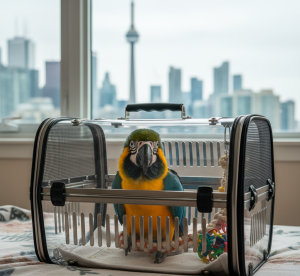
Can a bird fly in the cargo hold? Here’s what airlines allow, the real risks involved, and why cabin travel is safer for your feathered companion.
Is Flying Safe for a Parrot? What Canadian Law Actually Requires
Is flying stressful for parrots? Learn what Canadian law requires for safe travel and how to tell if your bird is truly ready to fly.
Microchipping and Leg Bands for International Bird Travel
Learn how to microchip your parrot for travel in Canada, plus leg band rules, so your bird meets international ID requirements before you fly.